Our Pick: Phytoextractum
Check price →Phytoextractum Kanna Review (2026): Cheap Powder & Whole-Plant
Phytoextractum is the specialist's kanna shop, raw whole-plant kougoed and ratio-based 100:1 extract, both starting around $5.99. We reviewed it to find who it's actually for, and where ratio labeling leaves you guessing.
By Justin Park · ~6 min · Updated 2026-06-14 · Official site ↗
★ Our Top Pick
Best Cheap Concentrate (Experts)
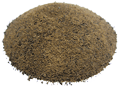
Kanna 100x Extract
Phytoextractum
The cheapest real concentrate on the shelf, potent and traditional, but ratio-labeled, so you measure by the milligram and trust the ratio.
Best Traditional Whole-Plant
Kanna Shredded (whole-plant)
If You Want a COA Per Batch
Kanna MT55 Powder
Not sure yet? Compare all 4 picks below ↓
If you've gone looking for raw kanna powder rather than a tidy capsule, you've probably landed on Phytoextractum, a botanical-specialist vendor that sells the unglamorous, experienced-user end of the shelf: whole-plant Sceletium tortuosum and high-ratio concentrates, both starting around $5.99. It is, by a wide margin, the cheapest way into real kanna on this site.
And for the right buyer, that's a genuine strength. Phytoextractum is a reputable specialist that stocks the traditional South African form of the plant (kougoed) alongside a 100:1 extract powder, with prices that undercut every standardized capsule we cover. If you already know kanna, own a milligram scale, and want to work with raw material instead of a fixed dose, this is a legitimately good shop.
But "specialist" is the operative word, and it cuts both ways. The reason this review frames Phytoextractum as an experts-only pick comes down to one label difference: it sells products by ratio (100:1) and by raw plant, which tell you a concentration ratio, but not a standardized mesembrine percentage. We rank on what a brand discloses, and a ratio is a different, looser kind of disclosure than a percentage.
The short version
- Phytoextractum is the cheapest entry point to real kanna we cover: both the 100:1 extract powder and the raw whole-plant (shredded kougoed) start from about $5.99, check current price.
- It's a reputable botanical specialist, not a mass-market supplement brand, which is exactly why it stocks the traditional raw whole-plant form most capsules never offer.
- The catch: Phytoextractum labels by ratio (100:1) and by raw plant, not by a standardized mesembrine percentage. A ratio tells you how concentrated the extract is relative to raw plant, not how much mesembrine you're actually getting.
- "100:1" means 100 units of raw plant were reduced to 1 unit of extract. It's a concentration ratio, NOT a guaranteed alkaloid percentage, two 100:1 extracts can still differ in potency.
- These are powders, so a milligram scale is required. You weigh out small amounts; you do not count pieces. That alone makes this a non-beginner shop.
- For experienced users who want cheap raw material to experiment with, or the authentic whole-plant kougoed experience, it's a great fit. For beginners or anyone optimizing potency-per-dollar, a standardized extract (disclosed % alkaloids) is the smarter, safer buy.
- Kanna raises serotonin like an SSRI, so do not combine it with an SSRI, SNRI, or MAOI without a doctor's sign-off, a caution that matters even more when you're dosing raw powder by hand.
| Product | Form | What the label tells you | Price | Who it's for |
|---|---|---|---|---|
| Phytoextractum Kanna 100x Extract | Concentrate powder | 100:1 ratio (concentration, not a mesembrine %) | From $5.99 | Experienced users with a scale |
| Phytoextractum Kanna Shredded | Raw whole-plant powder | Raw kougoed, no extract ratio or % | From $5.99 | Traditionalists who want whole-plant |
| LiftMode MT55 Powder | Concentrate powder | 5%+ total alkaloids, high mesembrine, COA/batch | $25 to $40 | Experts who want a disclosed % |
| Nootropics Depot Full-Spectrum Tablets | Quick-dissolve tablet | 3% mesembrine / 5% total alkaloids | $20 to $40 | Beginners & disclosed-potency buyers |
Phytoextractum vs the standardized picks, the difference is in the "what the label tells you" column. A ratio is not a percentage.
01 · Best Cheap Concentrate (Experts)
The Specialist PickKanna 100x Extract
The cheapest real concentrate on the shelf, potent and traditional, but ratio-labeled, so you measure by the milligram and trust the ratio.
Lab report: Labeled as a 100:1 ratio extract (100 units of raw plant reduced to 1 unit of extract), a concentration ratio, not a standardized mesembrine percentage; request the current COA from the vendor.
Phytoextractum's 100x is a ratio extract: 100 units of raw Sceletium tortuosum reduced down to 1 unit of concentrated powder. That makes it strong, cheap, and a favorite among experienced users who'd rather work with raw material than a fixed dose. As a powder, you weigh small amounts on a milligram scale, you don't count capsules, which is exactly why it's a specialist product and not a first bottle.
This matters because of how kanna works. As Harvey et al. (2011) documented, kanna acts through a dual mechanism, serotonin-reuptake inhibition plus PDE4 inhibition, and the serotonin side is driven specifically by mesembrine content. A standardized percentage lets you target that directly; a ratio lets you target concentration but not the alkaloid itself. None of which makes the 100x a bad product, it's a real, potent, traditional concentrate from a reputable specialist at an unbeatable price, it just means you're shopping on a ratio and your own careful titration rather than a measured spec.
As a botanical product, this has not been evaluated by the FDA and is not intended to diagnose, treat, cure, or prevent any disease.
- Form
- Concentrate powder
- What the label states
- 100:1 ratio (concentration, not a mesembrine %)
- Standardization
- Not standardized to a disclosed alkaloid %
- Axis
- Uplift / strong
- Dosing
- By milligram, a scale is required
- Where to buy
- Phytoextractum (direct)
What we like
- Cheapest real concentrate we cover (from $5.99)
- Genuinely potent ratio extract
- Reputable botanical specialist vendor
- Total dose control for experienced users
Worth noting
- Ratio labeling, no standardized mesembrine %
- Requires a milligram scale
- Not for beginners
- Can't compute true cost per standardized dose
Who should buy it: Experienced users who already know their kanna tolerance, own a milligram scale, and want the cheapest path to a real concentrate, and who are comfortable working from a concentration ratio rather than a standardized percentage.
What we don't like: The headline limitation is ratio labeling: 100:1 tells you concentration, not mesembrine content, so you can't compute a true cost per standardized dose or compare it head-to-head with a standardized extract. It also demands a milligram scale and careful self-titration, there's no fixed dose and no margin for eyeballing it. Pricing starts low but moves; confirm the current price.
Bottom line: This is the kanna for the experienced user who wants maximum concentration for minimum money and is comfortable reading a ratio instead of a percentage. At from $5.99 it's the cheapest entry to a real concentrate we cover. The trade-off is that 100:1 tells you how concentrated the extract is, not how much mesembrine you're getting, so you're trusting the ratio rather than a measured spec.
02 · Best Traditional Whole-Plant
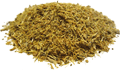
Kanna Shredded (whole-plant)
The authentic raw form, whole-plant kougoed for traditionalists, with the gentlest potency and the least standardization.
Lab report: Raw whole-plant Sceletium tortuosum (kougoed), no extract ratio and no standardized alkaloid percentage; potency reflects the natural plant, which varies.
Kougoed is the traditional South African form of kanna: the whole Sceletium tortuosum plant, shredded, rather than a concentrated extract. Phytoextractum stocks it, which most mainstream capsule brands don't, and that's the appeal, this is the closest thing on the shelf to how kanna has historically been used. Because it's raw and unconcentrated, it's the mildest material here gram-for-gram, and like every powder it's dosed by weight on a milligram scale.
For experimenters and traditionalists, that's the entire point, and a 3-month placebo-controlled trial of standardized kanna in 37 adults (Nell et al. 2013) found it well-tolerated, which is reassuring background even though that study used a standardized extract rather than raw plant. For anyone who wants a predictable, comparable dose, though, raw whole-plant is the wrong direction: there's no number to compare. It has not been evaluated by the FDA and is not intended to diagnose, treat, cure, or prevent any disease.
- Form
- Raw whole-plant powder (kougoed)
- What the label states
- Whole-plant Sceletium tortuosum, no ratio, no %
- Standardization
- None, natural plant potency, varies by batch
- Axis
- Mild / traditional
- Dosing
- By milligram, a scale is required
- Where to buy
- Phytoextractum (direct)
What we like
- Authentic traditional whole-plant (kougoed)
- Cheapest authentic form (from $5.99)
- Gentlest material here, not concentrated
- Rare to find from mainstream brands
Worth noting
- Least standardized option, no ratio or %
- Natural potency varies batch to batch
- Requires a milligram scale
- Hard to dose consistently or compare
Who should buy it: Traditionalists and experimenters who specifically want the authentic raw whole-plant (kougoed) form, accept that potency varies, and own a scale to dose it carefully.
What we don't like: It's the least standardized product we cover, no ratio, no percentage, and natural batch-to-batch variation, so dialing in a consistent, comparable dose is genuinely harder than with any extract. Strictly an experienced-user / experimenter purchase.
Bottom line: If you want kanna the way it has traditionally been used in South Africa, the raw, whole, unconcentrated plant (kougoed), this is the most authentic product we cover, and it starts at from $5.99. It's the gentlest option here precisely because it isn't concentrated, and the least standardized for the same reason: raw plant carries whatever the plant carries.
03 · If You Want a COA Per Batch
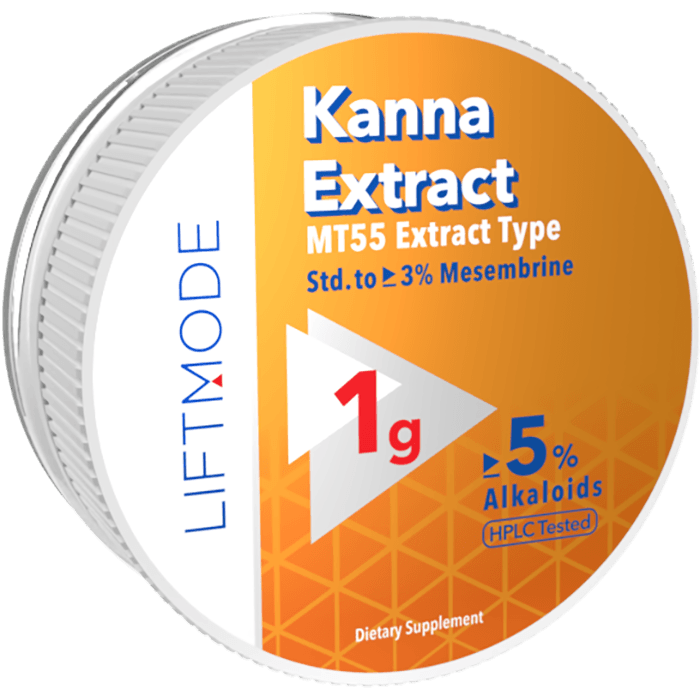
Kanna MT55 Powder
Still a powder for experienced users, but one that prints a disclosed alkaloid percentage and a COA per batch.
Lab report: MT55, standardized to 5%+ total alkaloids with a high-mesembrine profile; LiftMode publishes a COA per batch.
MT55 answers the exact question Phytoextractum's ratio labeling leaves open. Instead of "100:1," it states 5%+ total alkaloids weighted toward mesembrine, a measured percentage you can actually compare across products and use to compute cost per standardized dose. It's still a concentrate, still requires a milligram scale, and still isn't a beginner product; the difference is purely in the transparency of the spec.
LiftMode publishing a COA per batch is the kind of transparency that matters most when you're handling something this concentrated, and the per-dose cost stays reasonable because a little goes a long way. The serotonergic caution applies with extra weight at higher potencies.
- Form
- Concentrate powder
- Standardization
- MT55, 5%+ alkaloids (high mesembrine)
- Axis
- Uplift / strong
- COA
- Per batch
- Dosing
- By milligram, a scale is required
- Where to buy
- LiftMode (direct)
What we like
- Discloses a % alkaloid spec, not a ratio
- COA per batch
- Total dose control
- Comparable cost per standardized dose
Worth noting
- Several times pricier than Phytoextractum
- Strong/uplifting, not calming
- Requires a milligram scale
- Not for beginners
Who should buy it: Experienced powder users who want the same dose-by-the-milligram control as Phytoextractum's extracts but with a disclosed alkaloid percentage and a per-batch COA, the transparency upgrade.
What we don't like: It costs several times more than Phytoextractum's from-$5.99 entry, and like any concentrate it's strong and uplifting, the wrong direction for anyone seeking calm, and still not beginner-friendly.
Bottom line: If you like the powder format and the dose-by-the-milligram control Phytoextractum offers, but you want a disclosed potency instead of a ratio, MT55 is the direct upgrade. It's the same experienced-user category, a concentrate you weigh on a scale, but with a stated 5%+ alkaloid percentage and a batch COA behind it.
04 · If You Want Standardized & Beginner-Safe
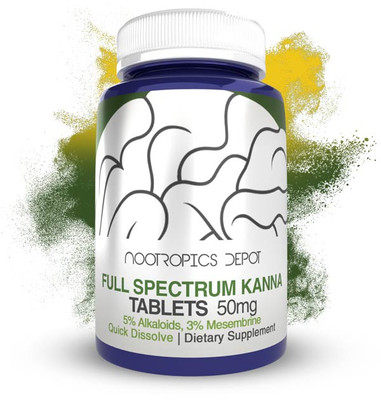
Full-Spectrum Kanna Tablets
The opposite of a raw powder, a standardized, splittable tablet that needs no scale and prints its alkaloid math.
Lab report: Standardized to 3% mesembrine and 5% total alkaloids; Nootropics Depot publishes batch testing and identity verification.
Phytoextractum asks you to weigh raw or ratio material and trust a ratio. Nootropics Depot does the opposite: a standardized full-spectrum tablet where the natural alkaloid ratio of the plant is preserved but locked to a known potency, 3% mesembrine for the serotonin side, with mesembrenone and the rest intact for the PDE4 side. There's no scale, no ratio math, and no batch-to-batch guessing; you can break a tablet to start low, and the quick-dissolve format means part of the dose absorbs in the mouth for a faster onset.
For a newcomer it's forgiving; for a regular user it's the daily driver that doesn't punish your wallet. The dual mechanism Harvey et al. (2011) described, serotonin-reuptake plus PDE4 inhibition, stays intact in a full-spectrum extract, and here you know the dose behind it. As a supplement it has not been evaluated by the FDA and is not intended to diagnose, treat, cure, or prevent any disease.
- Form
- Quick-dissolve extract tablet
- Standardization
- 3% mesembrine / 5% total alkaloids
- Axis
- Balanced
- Onset
- Faster than a capsule (partly buccal)
- Dosing
- Splittable tablet, no scale needed
- Where to buy
- Nootropics Depot (direct)
What we like
- Standardized AND full-spectrum (discloses %)
- No milligram scale required
- Splittable for a forgiving first dose
- Best cost per standardized dose here
Worth noting
- Earthy, bitter taste
- Direct-from-brand only
- Not the raw/traditional form some want
Who should buy it: Beginners, or anyone optimizing potency-per-dollar, who wants a standardized, disclosed-potency dose with no scale and no ratio math, the easy upgrade from raw powder.
What we don't like: It's direct-from-brand rather than Amazon, and the quick-dissolve taste is earthy and bitter, kanna's natural flavor isn't masked the way a flavored format hides it.
Bottom line: If Phytoextractum's scale-and-ratio workflow sounds like too much, this is the clean alternative. The full-spectrum tablet states 3% mesembrine and 5% total alkaloids, needs no milligram scale, and can be split for a forgiving first dose, the standardized, beginner-safe answer to a raw powder.
How we chose
We rank kanna on what a brand is willing to disclose, not on marketing. Five things decide our order: disclosed alkaloid content (a stated mesembrine or total-alkaloid percentage beats a ratio or a raw-plant weight), standardization and COA transparency, dose consistency, formulation fit for the intended use, and cost per standardized dose. Phytoextractum scores extremely well on price, on stocking the authentic traditional form, and on being a real specialist vendor, and it loses ground on the disclosed-potency line, because ratio and whole-plant labeling can't be reduced to a standardized percentage the way LiftMode's MT55 or Nootropics Depot's full-spectrum extract can.
We don't run clinical trials and don't pretend to. Effects described here are what users and the published Sceletium research commonly report, framed experientially, never as medical outcomes. The human clinical base for kanna is small (studies of n=16 to 37), short, mostly on the patented Zembrin extract rather than on raw plant or ratio extracts like these, and partly industry-linked; we say so rather than oversell it. This is an independent review, we earn a commission if you buy through our links, but no brand pays for placement or a rating.
Questions, answered
Is Phytoextractum kanna good?
For what it is, a reputable botanical specialist selling raw whole-plant and ratio-based concentrate at the cheapest prices we cover (from about $5.99), yes, it's a genuinely good shop for the right buyer. That buyer is an experienced user who owns a milligram scale and wants raw material to work with, or the authentic traditional whole-plant (kougoed) form. The honest limitation is that it labels by ratio (100:1) and by raw plant rather than by a standardized mesembrine percentage, so you can't compare potency the way you can with a standardized extract. For beginners or anyone optimizing strength-per-dollar, a standardized extract is the safer, smarter buy.
What does 100x kanna extract mean?
"100x" (or 100:1) is a concentration ratio: 100 units of raw kanna plant were reduced down to 1 unit of concentrated extract powder. It tells you the material is heavily concentrated relative to the raw plant, but it is NOT a guaranteed alkaloid percentage. It doesn't tell you exactly how much mesembrine (the main active alkaloid) you're getting, and two different 100:1 extracts can vary in potency. If you want a number you can actually compare and dose against, look for a standardized percentage (e.g., 5% total alkaloids) instead of, or alongside, the ratio.
Is raw whole-plant kanna worth it?
It depends on what you want. Raw whole-plant kanna, the traditional South African form called kougoed, is the most authentic version of the plant and the gentlest material gram-for-gram, because it isn't concentrated. For traditionalists and experimenters, that authenticity is the whole appeal, and Phytoextractum stocking it from around $5.99 is a real plus. The downside is that it's the least standardized option there is: no ratio, no percentage, and natural batch-to-batch variation, so dialing in a consistent, comparable dose is genuinely harder. If you value authenticity and own a scale, it's worth it; if you want predictability, a standardized extract is the better choice.
Do I need a scale for Phytoextractum kanna?
Yes. Everything we cover from Phytoextractum is a powder, the 100:1 extract and the raw whole-plant, and powders are dosed by weight, not by counting pieces. A milligram scale (one that resolves to about 1mg) is required, especially for the concentrate, where the gap between a measured dose and a guessed one is the difference between a pleasant experience and nausea. If you don't want to own and use a scale, choose a pre-dosed standardized format instead, like the Nootropics Depot quick-dissolve tablet, which you can simply split.
Can I take kanna with antidepressants?
Not without a doctor's sign-off. Kanna raises serotonin much like an SSRI does, so combining it with an SSRI, SNRI, MAOI, or other serotonergic medication is the main safety caution for every kanna product, and it carries extra weight with raw powder you're dosing by hand, where it's easier to take more than you intended. This is a precaution based on the mechanism, not medical advice, talk to your clinician about your specific medications before combining anything.
References
The human research on kanna is genuine but small, a handful of trials, mostly on the standardized Zembrin extract. These are the primary sources we cite, linked so you can read them yourself.
- 1.Harvey AL, Young LC, Viljoen AM, Gericke NP (2011). Pharmacological actions of the South African medicinal and functional food plant Sceletium tortuosum and its principal alkaloids. Journal of Ethnopharmacology. Identified kanna's dual mechanism, serotonin-reuptake inhibition (5-HT transporter) and PDE4 inhibition, in vitro. PubMed · DOI
- 2.Nell H, Siebert M, Chellan P, Gericke N (2013). A randomized, double-blind, parallel-group, placebo-controlled trial of Extract Sceletium tortuosum (Zembrin) in healthy adults. Journal of Alternative and Complementary Medicine. A 3-month placebo-controlled trial (n=37) found 8 mg and 25 mg/day were well-tolerated, with no significant changes in vitals or blood chemistry. PubMed · DOI
Keep reading
The Best Kanna Powder, Ranked
Raw, ratio, and standardized powders compared on disclosed potency and value.
The Best Kanna Extracts, Ranked by Potency & Purity
Standardized tablets, powders, and concentrates compared on alkaloid math.
What Is Kanna Extract?
Extract ratios vs standardization vs raw plant, how to actually read a kanna label.
How to Take Kanna
Methods, onset, and why powders need a scale to dose safely.
Kanna Dosage Guide
How much kanna to take by format, and how to find your dose safely.